About That Deep-Edit…

Well-meaning, but misguided, friends often question me when I admit I’d prefer the traditional publishing route over self-publishing.

Sure, both are fraught with decisions, fears, and worries, but in my heart, I want somebody standing beside me when I face them.

Somebody like an agent. Or an editor.

You see, few of us are so exacting that we don’t need another set of eyes on what we write.

To catch our misspellings, wonky sentences, even factual errors.

I learned that early in my newspaper career.

Continue reading

Write First; Then Hawk

A few years ago, I went to a writing conference where we were encouraged to start building our “platform” before we were ready to publish our book.

(“Platform building” is basically marketing of you as a writer. It encompasses those things you do to engage potential readers and includes a website, blog, and social media.)

Continue reading

From Student to Employee

I think I alluded to this in my last post, but now that graduation is over, now that we’re back from our miserable trip abroad, the BIG item on the To-Do List for my son and me is getting him relocated.

Out of state.

Far out of state.

For his new job.

Not a part time internship.

A real JOB.

With a paycheck. And benefits. And bills.

Because My Favorite Domer is entering the World of the Employed.

Woo-Hoo, can you see me doing the Happy Dance?!

What is it they say, Parenting is the only job that, once you get really really good at it, you’re unemployed.

Maybe, but I believe I’m a long was from that.

Anyway, relocation means work. Lots of work.

And expenses. Mucho expenses.

  • Like an apartment.
  • And stuff to go into the apartment — furniture, towels, cooking items, food.
  • And a car, since he didn’t have one at college, by his own choice.
  • And insurance.
  • And a new cell phone (because his is woefully outdated, has an annoying proclivity to shut down willy-nilly, has buttons in the wrong places, and won’t keep a charge).
  • And a laptop (because the battery on his overheats, shutting down the entire system without warning).
  • And working people clothes (as opposed to T-shirts, jeans, and sneakers).

It’s exciting to be sharing this time in his life. And I’m ever-so-grateful that he’s found gainful employment (and doesn’t have to hang around here being bored).

So don’t ask me if I’m working on my novel.

With this much on my mind, I’m doing good just to keep up with this blog!

And it’s okay. Really.

As my late dad used to say, “Rome wasn’t built in a day.”

Nor is a novel.

When LIFE interferes with your writing, you have two options:

  1. Rail against it, squeeze out time to write when you can, then throw it all out when you realize it sucks, and rail some more at the injustice of it all, or
  2. Roll with the punches, write when you can, and don’t sweat it when you can’t.

I’m trying the second route. I’ve tried the first one before, and it doesn’t work.

Too much angst.

Rolling with the punches feels better.

I like to think my novel is percolating, that I’m letting the creative juices simmer while I tend to everyday things.

And besides, I’d boxed myself into a terrible corner, one I can only hope time will help me resolve!

But I’m putting my Muse on notice — I’ll be back.

Excuses, Excuses

I should have been writing my blog.

But on Tuesday, I spent all day working on my novel.

You know how it is — some days, the words just seem to flow.

And you don’t have to spend countless hours researching stuff you don’t know in order to write it as if you do.

And the ideas are ripe for the picking, and the dialog actually comes out like people talk.

How could I leave all that, even for a second, and transfer my attention to this blog? Or anybody else’s?

I should have been writing my blog.

But on Wednesday, I had to get together with a friend I haven’t seen in a couple of months.

To rest and recharge, sort of.

And we had to poke around at an antiques store, looking over vintage jewelry and books and what-nots.

And we had to satisfy our mutual craving for Chinese food.

And then we had to sit on her homemade porch swing, watching the grey clouds swirl overhead, listening to the geese honking on the nearby pond, feeling the chill-bumps form on our arms as a cold front started to come through.

How could I leave all that and transfer my attention to this blog??

I should have been writing my blog.

But on Thursday, I had to go shopping.

Again.

And I finally found something to wear for My Favorite Domer’s Commencement.

Which takes place next month.

Next month!

I’ll be set as long as the weather warms up a bit.

And I don’t gain a single pound.

It’s not my fault it took all day!

How could I leave all that and transfer my attention to this blog??

I should have been writing my blog.

But on Friday, I had to haul Darling Sheltie Dog to the vet’s for a checkup on his thyroid.

It’s fine, thankfully.

And I had to haul Mom to a doctor’s appointment.

She, too, is fine, thankfully.

It’s not my fault errands took all day.

Life sometimes takes over and waylays us from doing what needs to be done.

Like writing my blog.

So dear friends, hang on. I’ll be around to catch up with you as soon as I can.

In the meantime, woo-hoo: I’m writing my blog!!!


Why I Don’t Write Memoir

Earlier this week, I went hunting in my closet for something from my youth (another post for another time).

I didn’t find it, but what I found stunned me.

A big box filled with my past.

There were old newspaper clippings, journals, my diary, and letters.

The topmost letter was in a hand I didn’t readily recognize. Nor did I remember the address.

As I opened it and started to read, it dawned on me who it was from — an old boyfriend from college.

One who’d broken up with me for reasons I didn’t understand then (and don’t recall now).

I read the next letter — also from him — then a poem I’d printed lamenting the demise of us.

Two thoughts immediately came to mind:

  1. Why did I save this stuff?
  2. Who else in my family had seen it?

Feelings engulfed me and once again, I was 21. A very young 21. Who thought knew she was in love.

Hopelessly.

I read his words, silly words, funny words, and I remembered his face. His eyes. How smart he was.

How good for each other I thought we were.

But he wasn’t ready to settle down. He had a career to begin, money to make, growing up of his own to do.

Sorority sisters all around me were getting pinned or engaged. Planning weddings, choosing silverware and dish patterns. Poring over Brides Magazine for gowns and attendants’ dresses, anticipating honeymoon destinations.

I thought I was missing out. Little did I realize that those things would come to me, too.

In time.

But not with that guy.

One nice thing about this Internet Age is the ability — if you’re somewhat savvy — to look up just about anybody.

To satisfy your curiosity over “What became of old xxxxx?”

I’d rather not do that. I’d rather leave him as I remember him — young of body, charming, witty, boyishly handsome, a good friend. Though nothing more.

Note: And now you all know why I don’t write memoir — it’s too painful. I admire writers like my friend Kathy who dig deep, unearth buried feelings, bring them to the surface, examine them beneath a magnifying glass, and glean something of substance from them. Something that others can learn from.

Not me. Perhaps I’m too private. Or too sensitive. But I’d much rather write suspense/mystery stories where I can “kill” people off, manipulate facts in favor of a good read, create neighborhoods and characters to my heart’s content. And entertain.

Tell me, if you’re a writer, what’s your genre of choice? If you’re a reader, what kind of stories keep you spellbound?

Five Things I Learned From Lee Child

The January issue of Writer’s Digest contains an interview with bestselling thriller author Lee Child that I found fascinating for several reasons:

  1. “Lee Child” is actually a pen name.  People who read my blog know by now that I, too, will be selecting a pen name. My real name is far too common (and I’ve never liked being a “Debbie”). Unlike Child, whose real name is Jim Grant, I’m not “playfully” toying with various possibilities; Virgo that I am, I’m methodically trying to come up with something that’s me, something I can grow into, something that will serve me for the long haul — because I sure don’t want this aggravation again down the road!
  2. Lee Child debunks the myth of writing what you know. He says, “In the thriller genre, for instance, nobody knows anything that’s worth putting in.” Rather, he advises writers to write what they feel. That makes sense on a lot of levels. Shoot, I’ve never killed anybody, but my yet-to-be-sold first novel is full of murders! The Internet puts information on a wealth of topics right at our hands (just be sure you research the research!). With facts to back you up and feelings to provide the oomph, you’re steps closer to writing a story people will want to read.
  3. Lee Child says you don’t need vices to write. Other than admitting to being nosy and watching people, Child says he doesn’t claim the oft-mentioned writers’ habit of downing too much alcohol. Despite my Irish heritage, neither do I. In fact, I cringe when I hear of another writer battling seen or unseen demons through drugs or liquor. Or prescription pills or oversleep. I don’t have to be an alcoholic to understand one’s inability to just say “no.” Nor do I need to gain 200 lbs. to empathize with an overweight individual.
  4. Lee Child came to writing rather late. Fired from his job at an English TV channel just before his 40th birthday, Child turned to fiction writing. He says working all those years gave him good work habits and skills; he also had absorbed life. He explains, “I honestly believe that writing is possibly the only thing that not only can you, but you should do it later.” I tend to agree. Now I’m sure there are many young writers fully capable of telling a gripping tale (and plenty of older ones incapable of that), but for myself, I know I wouldn’t have had the courage necessary to call myself a writer if I hadn’t experienced life’s ups and downs over the years.
  5. The publishing industry has changed since Lee Child came on the scene. Child admits he signed with the first agent he queried and the first publisher they pitched his novel to. Amazing, huh? Especially to those writers who could paper a room with rejection letters. But as he says, “All that matters is coming up with a great original story.” Amen!

So, do you have a favorite mantra when it comes to writing? Something the rest of us could benefit from? Do share!

Motivation for Writing

I’ve been re-reading Bill O’Hanlon’s book “Write is a Verb,” and found that Chapter 2 really shouted at me.

Chapter 2, “Writing Begets Writing,” points out what should be obvious — sitting down at the computer/legal pad and scratching out words will eventually result in getting your writing done.

But many writers are procrastinators. We excuse ourselves from the task for a variety of reasons — we don’t have a huge block of uninterrupted time, for instance. Or there’s something else — running the kids to lessons, cooking dinner, exercise class — that demands our attention.

Perhaps we fear we’re not “good enough.”

Perhaps real life is interfering. Some of us do have other jobs; most of us have families.

Time is always an issue (sadly, no one has figured out how to squeeze more than 24 hours into a day!)

O’Hanlon says that if you want to be a writer, you will write.

A plumber, he says, doesn’t appear at your house fretting over failure or “plumber’s block.” Neither should writers.

Plumbers don’t wait for a perfectly quiet house in which to work, or spend time and money going to and from a gazillion plumber’s conferences, or read countless books on how to be a plumber.

They dive right in, and so should we.

O’Hanlon advises writers not to give feelings too much attention. Feelings, he says, often are wrong and tell us we can’t write.

“So, thank those feelings for sharing and then tune them out. Get on with it. Don’t wait for the Muse to visit,” he says.

Anything that takes you away from your goal — writing and publishing — can be considered a distraction, no matter how “necessary” or “helpful” it might be. That includes writing exercises (“stop practicing and start producing”), making detailed outlines or doing extensive research, checking and re-checking e-mail, “having” to be in the mood to write or be surrounded by the right music and a scented candle.

O’Hanlon says, “If I had to choose one thing that separates the wheat from the chaff, it would be persistence. It certainly isn’t talent. I’ve coached some people with amazing talents who remain unpublished because they have not persisted.”

The bottom line? Put your bottom in the chair and start writing!

What’s a Writer Worth?

Domer just loves to push my buttons.

Recently, I was bemoaning an article in Writer’s Digest magazine, where author Jane Friedman discusses the basics of e-publishing.

“Independent novelists charge very little for their work, usually between $.99 and $2.99,” Friedman wrote.

‘That sounds about right,’ Domer said. ‘Nobody knows you. Why should they pay good money for your book? Besides, wouldn’t it be better for you to charge $1 for a book and sell a million copies than to sell only 10 copies for $30 each?’

Not necessarily. If “nobody” knows you, how are you going to sell a million copies?

More to the point, I for one haven’t labored the better part of six years on my series to sell each book for a measly dollar. It’d be too demeaning.

Look at it this way: To become a doctor in the U.S., a person must spend four years in undergraduate university, four years in medical school, three to five years in residency, and two to three years in a fellowship. Nobody does all that and charges each patient $2 per visit!

Why should what I do be of less importance?

True, writing novels isn’t exactly saving lives, but how many doctors are saving lives? Honestly, don’t they sometimes make people sicker — from worry and fear, from side effects of medications or procedures?

Domer is looking at it as a numbers game. Fair, since he’s studying Business. And you can’t argue with his math — one million copies at $1 each totals $1 million, whereas 10 copies sold at $30 each amounts to only $300. That’s a big difference. Huge, even.

But how many novelists are trying to “get rich” from their work? Isn’t it more likely that we can’t NOT write? That we believe we have something to say, something that might change another person’s life? That we might take our readers on a thrilling journey, far from their possibly mundane existence? That we might scare the socks off them — and ourselves — through the power of our written words? That we might inspire them to be their best, to unshackle themselves from burdens they don’t need to bear?

I say creative people have endured far too much devaluation over the centuries of civilization. It’s time we appreciated our own worth and realized our world would be a wretched place without writers, musicians, and artists. If we don’t believe what we do is worthwhile, how can we expect others to believe it? And, believing it means rewarding it.

Any thoughts from my fellow creators?

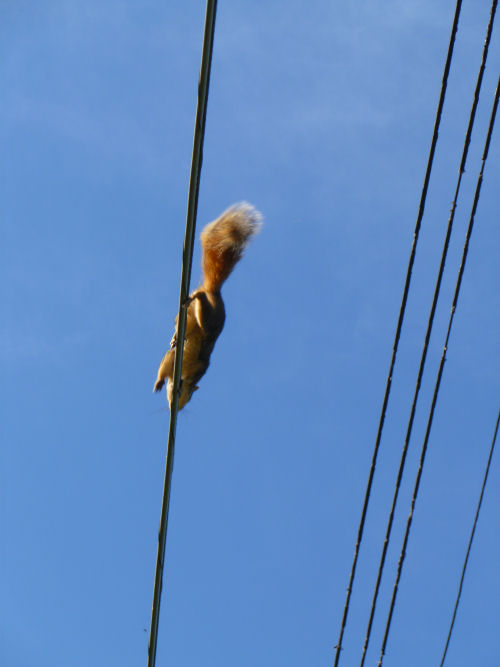
A Squirrel’s Journey

Once upon a week in June
A squirrel thought he’d try
To test his acrobatic skills
Across a cable high.

“I think I can.”

Peering at the ground below
He saw something furry.
Something reddish, something loud,
Something in a hurry.

Squirrel swallowed hard and flicked his tail
Deciding to follow through
On plans to conquer tightrope fear
By walking in plain view.

“I think I can.”

The Sheltie barked, the Human clicked,
The little squirrel pressed on
And midway ‘cross the wire so high
The squirrel thought he was gone.

“Uh-oh, easy does it!”

Gathering courage, the acrobat
Continued to make his way;
Step by step he journeyed forth
Despite the annoying fray.

“So near, yet so far.”

And oh, at last, the little squirrel
Found safety in his quest
Another power pole in sight
To offer needed rest.

“YES!! Happy Dance!”

A squirrel’s life is brief, they say,
Two years, or maybe three.
So wouldn’t they be better off
Staying in tall trees?

Possible End of an Era

It nearly breaks my heart what’s happening to my former profession of journalism.

Once upon a time, newspapers were a training ground for wanna-be writers. Often-crusty editors whipped into line whole generations of young reporters, fresh from J-school with stars in their eyes and hopes of uncovering corruption. Another Watergate, perhaps.

And maybe even winning a Pulitzer in the bargain.

When I recall how naive we all were, how patient our editors were in teaching us the things we didn’t know, I have to smile.

My first “real” job out of college was as a reporter for an evening daily newspaper in Texas, covering what was deemed the “dinner circuit.” Every day, I’d be treated to lunch or dinner with one or another service club (Lions, Rotary, Kiwanis, etc.), and I’d gather information about their members for inclusion in a twice-weekly column I wrote. Birthdays, anniversaries, funny stories, all were fodder for my columns. Evenings, I attended meetings — area city councils, transportation boards, etc. — then wrote up a news story for publication in the next day’s paper.

My bosses lived on Maalox and cigarettes, chugging the former like water and puffing until clouds of smoke hung overhead (some even lit a new one before finishing the old).

The tapping of keyboards, the rushing around of reporters, the clanging of telephones — a newsroom wasn’t a quiet oasis! But the sharing of ideas and stories and humor, the excitement of hearing something new before anybody else heard it, the camaraderie, made it a fascinating and fabulous place to work.

Every once in a while, we’d hear of a colleague who was penning “the great American novel” in his or her free time. Or one who had aspirations of swapping newspaper reporting for magazines. Or public relations. Or for some politician’s press corps.

Our digital age has changed lots of that.

Maybe the saddest change is an announcement by The Times-Picayune in New Orleans. They plan to cut back publication this fall to just three days a week. After 175 years of service.

If that happens, NOLA will be the largest city in the U.S. without a daily paper.

Sure, printing revenues are down. But cutting the newsroom staff by a whopping 50 percent in favor of an online version? In a city where many residents don’t even have Internet connections?

The marketing department will be slashed to one person. Special section employees, library, and human resources — all cut. Pressroom severed by nearly 40 percent.

I never worked for the T-P, but having worked on other newspapers for about two decades, I can easily put faces to these statistics. They could have been my friends, my colleagues. We could have laughed together and shared successes.

Now I’m crying for them, their families, New Orleans, and my old profession.

Something special is dying.